Dual-polarimetric attenuation correction
Dual-polarimetric attenuation correction is a collection of algorithms, using the unfolded and conditioned PhiDP.
These algorithms may be performed in real-time within the RVP10 signal processors, or within the IRIS application software.
| RVP or IRIS | Description | Advantages and Disadvantages |
|---|---|---|
| RVP10 DP Attenuation Correction Processing |
Ray data are processed in the RDA, and the bin level moments are output in real-time for each range bin. |
The RDA software can apply immediate corrections with the signal processor being available on real-time data output. This becomes important in mission critical now-casting within the 0 ... 1 hr time frame, where the latest observed information is needed for precise decision making. With RDA, all moments are available in every bin. When performing the function in IRIS, certain moments within the bins are thresholded. This approach is well suited for applications where IRIS software is not active, since the particle type can be displayed directly by the customer's display software. |
| IRIS DP Attenuation Correction Processing |
Dual polarization data comes from RVP10, or from a third party processor, and are passed to an IRIS/Radar or an IRIS/Analysis system that is enabled with the dual polarization feature license. The bin level algorithms produce ingest data, which are formatted as RAW products for archival, or for rerouting in the network. The correction algorithm can also be applied to historical data. |
IRIS processing has an advantage since the original Z and Zdr moments are uncorrected for attenuation; IRIS makes new data types. IRIS processing allows for creating the corrected moments with archived data. This allows you to compare the results of the correction. Disadvantages to using IRIS are the time delay to have the corrected moments and that data is likely already been thresholded causing some range bins to have missing data. |
Signal attenuation in precipitation is a well known problem for weather radars using smaller wavelengths, like 3 ... 5 cm (1.18 ... 1.97 in) in the X- and C-band spectrums. The attenuation causes a decrease in the Z and Zdr measurements, making their use in quantitative analysis limited. The attenuation effects also impact the outcomes of the 'fuzzy logic' set of algorithms like HydroClass. It is important to estimate the amount of attenuation, and make corrections to the Z and Zdr data types prior to processing algorithms. These corrections ultimately improve the ability to accurately estimate rainfall, differentiate hydrometeors, and assess data quality metrics.
In case of the dual polarization radar, the differential propagation phase moment PhiDP, provides an excellent method to estimate attenuation of Z and Zdr, as the change in PhiDP is directly related to the liquid water content along the propagation path. PhiDP is not affected by attenuation or calibration errors, but allows large, accurate corrections.
The traditional single polarization attenuation correction is based on the following relationship:
Equation 1
A(r) =
      a[Z(r)]b
where A(r) is the specific
attenuation and Z(r) is the intrinsic reflectivity at any particular range
gate. This particular equation is implicit, where an unknown value A(r), is
expressed through another unknown value Z(r). The expression to solve for
total two-way attenuation is:
Equation 2
dBZc = dBZ + 2C∆r∑Z
        E
where the 2C∆r∑Z E
term estimates the total two-way attenuation to the range bin, based on the accumulated
reflectivity measurement. C and E are constants in this estimation. This equation becomes
unstable very quickly and must be highly constrained in order that the corrected reflectivity
does not end up having less value than the original.
With a dual-polarization radar, an independent estimate of the specific attenuation is possible:
Equation 3
A(r) = α
        Kdp(r)
In practice, the PhiDP(r) measurements to product Kdp have much lower accuracy than Z(r), and deviate significantly from the pure “propagation” component. However, the estimate of total cumulative attenuation along the radial is quite accurate and can be used as a constraint for the range specific attenuation corrections.
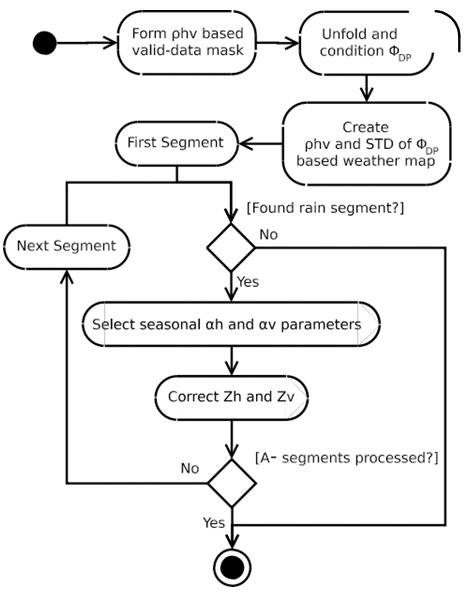
The IRIS/RDA implementation of dual-polarimetric attenuation correction is illustrated in the following figure.