
HydroClass FAQ
The following list is a compilation of issues encountered when using HydroClass in the field.
Q: How does HydroClass treat typical failure cases related to dpolapp.conf, such as:
-
Configuration file missing?
A: switches off until restart of IRIS/RDA.
-
Syntax errors in dpolapp.conf parameter lines?
A: switches off until file is fixed.
Q: How to feed in the melting level (ML) value as an external input to HydroClass?
A: When operating:
- RVP10 with IRIS/Radar
setup_change -loadtool, see SRI Product documentation - RVP10 without IRIS, contact Vaisala
- IRIS/reingest, the ML stored in RAW is used
To use these momentary values of ML, HydroClass configuration dpolapp.conf must be set up with:
dpolapp.Quality.iAux[0] = 0Alternatively, you can edit and update (either manually or with customized script tools)
dpolapp.Quality.iAux[0] = 1and
dpolapp.Quality.iAux[1] = 3500(where 3500 represents an example ML value, meters above mean sea level)
Q: How to monitor the ML value used/in use?
A: When operating in IRIS/Radar, use the utility command:
setup_change - list | grep ifalls.
When operating plain RVP10, use dspx > Mp
Q: When running HydroClass in distributed PC architectures such as RVPO900/AMR:
-
Where is the HydroClass configuration in use?
A: At PC running IRIS/Radar
-
Where to update the melting level with
setup_change?A: At IRIS/Radar
Q: How do HClass data look when HydroClass is tested using noise source input?
A: In commissioning phase and anytime, a viable method of testing functionality of HydroClass is to couple a coherent noise source to RVP10 IF inputs (for example, AMR built-in noise).
HydroClass can process such a data stream, by configuring RVP10 appropriately.
Observing HClass data
stream with ascope, for example, see the data in the following figure.
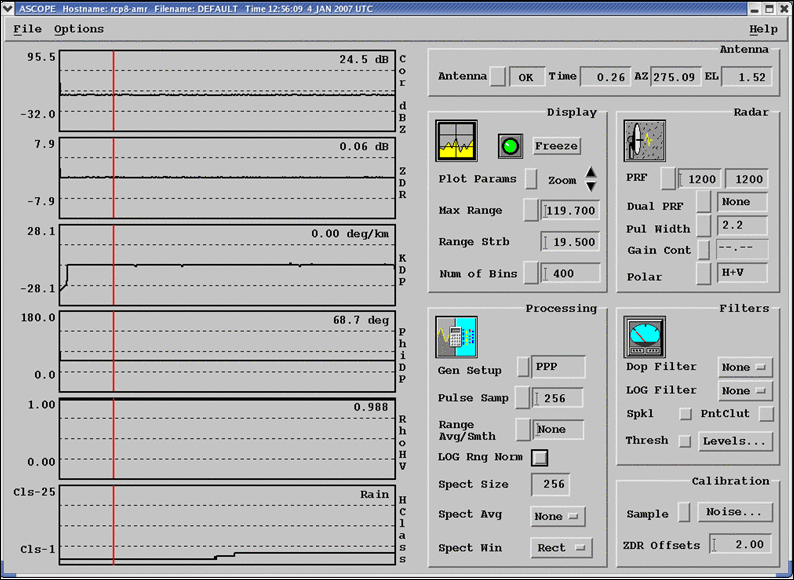
 | HydroClass is in default configuration and uses the melting layer height value given in the configuration file (2300 m). |