

Reflectivity
It is convenient to say things in atmosphere reflect the radiation, but backscattering is the accurate physical term. It is measured in Z (radar reflectivity factor) and often expressed in dBZ (radar reflectivity).
The famous radar equation from classical optics says
- P is the measured average power (in Watts) of several samples at the radar
- r is the range to the bin
- L is attenuation
- C is radar (hardware) constant
- K is the refractive index and depends on the dielectric properties of the particle
For meteorologists
For cloud physics, Z is a sum where is the number of particles with diameter per unit volume in the atmosphere. That means, that one droplet with diameter 4 mm (0.16 in) gives 4096 times as much energy as a 1 mm (0.04 in) droplet. And that we can't know if there is one droplet of 2 mm (0.08 in) or 64 droplets of 1 mm (0.04 in).
Z varies between 0.001 and 10,000,000. To get understandable numbers, we use a decibel scale:
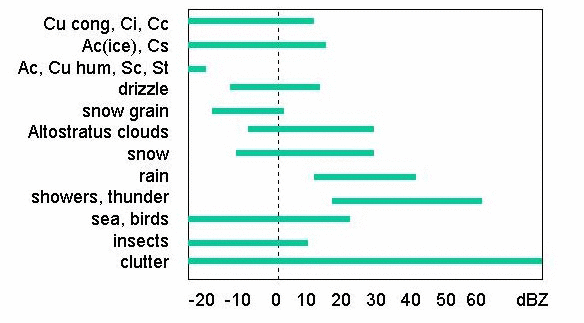
The following figure shows typical values for various phenomena in the atmosphere. You can see that reflectivity strength alone is not enough for target identification.
For hydrology, we need an equation to combine
radar reflectivity to rainfall rate. All of these equations are empirical and approximate,
since Z is proportional to D6 and
precipitation rate R (mm/h) is proportional to
D3.7. Also, we must assume something about drop sizes. For 64 drops of
diameter 1 mm (0.04 in) or one drop, diameter 2 mm (0.08 in), Z is same,
R is not. A good first guess is the classical Marshall Palmer
equation:
which equals to