

Bins, sweeps, and volumes
As the radar rotates around its axis 360° in a sweep, the weather radar transmits microwave pulses into the atmosphere and receives signals reflected off hydrometeors, such as rain, hail, or snow. After a sweep, the radar usually changes its elevation and starts a new sweep.
The reflection measurements from a pulse are sorted into bins. A bin is a single sample of weather data detected at a known direction, altitude, and distance from the radar site. The radial size of a bin increases with distance, so bins further from the radar site cover a larger area than nearby bins. Each sweep typically contains the same number of bins independent of the elevation.
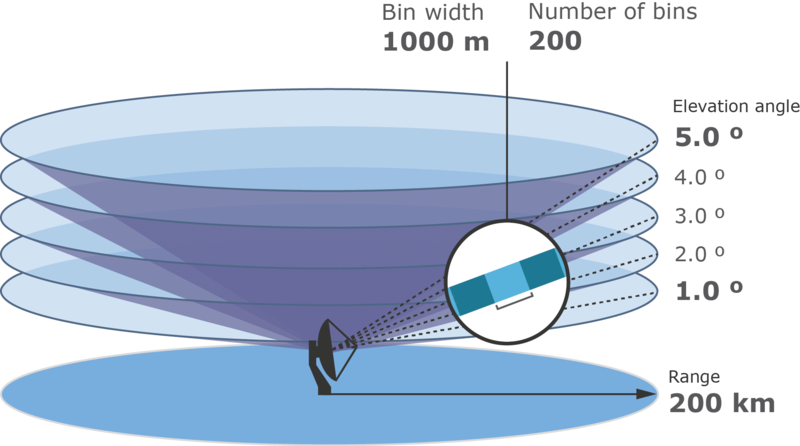
Volumes, a complete set of raw measurement data collected during sweeps, are used to calculate a model of the atmosphere. The maximum volume is half of a sphere (from 0° elevation upwards), but other shapes are more typical.