

HydroClass Fuzzy Logic
HydroClass methods use the fuzzy logic approach to polarimetric radar echo identification. Fuzzy logic allows algorithms to cope with varied levels of consistency, instead of exclusive statements of "yes" and "no". The fuzzy logic outputs can be thought of as degrees of consistencies. In most published literature and in the Vaisala documentation, these output values are known as the rule strengths (RS).
The rule strengths should not be confused with probabilities because the fuzzy memberships and rules typically represent empirically defined sets, rather than statistical likelihoods of events. The latter relates to the frequentist approach to probability. Fuzzy logic is well suited for identifying radar echoes and hydrometeor types because the radar moment signatures of different radar targets and hydrometeors are not mutually exclusive or unique.
The input variables to a fuzzy logic algorithm
are first passed into membership functions (MBF). Membership functions quantify the
consistency of the particular input variable within a specified output set. A value of 0 means
the input variable is not included for a given set and a value of 1 describes a fully included
variable. Values between 0 ... 1 characterize partial or fuzzy membership. Membership
functions can be one-dimensional or multi-dimensional. For example, consider the use of
reflectivity (ZH) for characterizing hail. It is known
empirically, that for lower reflectivity values below ~45 dBZ, the presence of significant
hail is unlikely. Using this knowledge, a one-dimensional membership function can be designed
for this simple case, shown in the following figure.
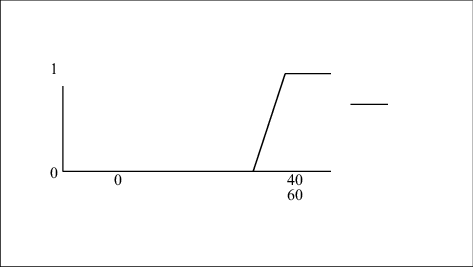
Using this membership function alone, a reflectivity at range bins of lower values implies a rule strength of 0 for hail, that is, the observation is inconsistent with hail. With multiple radar moments available as input, the rule strength for hail is an appropriate functional combination of all the membership functions using the inputs. Multiple outputs can be evaluated by constructing rule strengths to each outcome hypothesis. A deterministic outcome is obtained by comparing the rule strengths, at each range bin.