

RAIN1 Scheduling with GAGE Product
The scheduling algorithm for generation of the
RAIN1 product is different from the standard
RAIN1 scheduling since the product generator must await the arrival
of both the CAPPIs and the GAGE product for the
previous hour. To account for the delay in the arrival of the GAGE
product, a Gage Wait Time is defined in IRIS . In the following figures, this is labelled WaitG.
The notation shows a time line which represents the data time, that is, in the case of a CAPPI, this is the time that the volume scan was started based on the clock on the radar computer which may be different than the clock on the computer where RAIN1 is generated. In the case of a GAGE product this is the time exactly on the hour, at the end of the accumulation hour. Vertical bars show even hours.
Case 1A: Normal Case, CAPPIs and GAGE Arrive

This is the normal case when both the
CAPPI and the GAGE products arrive. The
GAGE product arrives sometime after the hour, but in Data
Time it is plotted exactly on the hour. The RAIN1 product
is run as soon as the GAGE product arrives and the first
CAPPI from the next hour arrives.
Case 1B: CAPPIs arrive, GAGE Arrives for a Future Hour

Here there is a missing hour in the CAPPI product stream. The RAIN1 product runs (without GAGE correction). The assumption here is that the GAGE products are arriving in time order, and the missing hour's data never appears.
Case 1C:CAPPIs Arrive, but GAGE Does Not

Here the GAGE product
does not arrive. The RAIN1 product runs (without
GAGE correction) when the local time on the product computer is
past the arrival time of the last input CAPPI plus the
Tail and WaitG times. The Tail time is
difference between the data time of the last input and the next integer hour. The
WaitG time is the Raingage Arrival Wait Time from .
Note that if the GAGE product eventually arrives, it is ignored.
Case 2A: GAGE Arrives, But the First CAPPI in the Next Hour Does Not
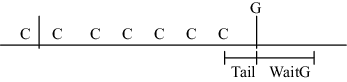
This is similar to the previous case. In
this case, after the Tail and WaitG times have elapsed,
the product runs using the available CAPPIs in the prior hour. There
is a GAGE correction and the RAIN1 algorithm
uses all the available CAPPI products.
Case 2B: Neither GAGE nor the First CAPPI in the Next Hour Arrive

This is nearly identical to the Case 2A,
that is, after the Tail and WaitG times have elapsed, the
product runs using the available CAPPI products in the prior hour
except that there is no GAGE correction.
Degenerate Case: No CAPPI's Ever Arrive
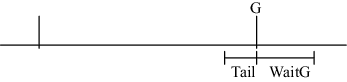
In this case, no RAIN1 product is generated.