
IF bandwidth and dynamic range
Components of the receive signal path, particularly the IF filter bandwidth, should be wide enough so that they do not distort the receive signal. Both amplitude and phase response at the signal bandwidth are important.
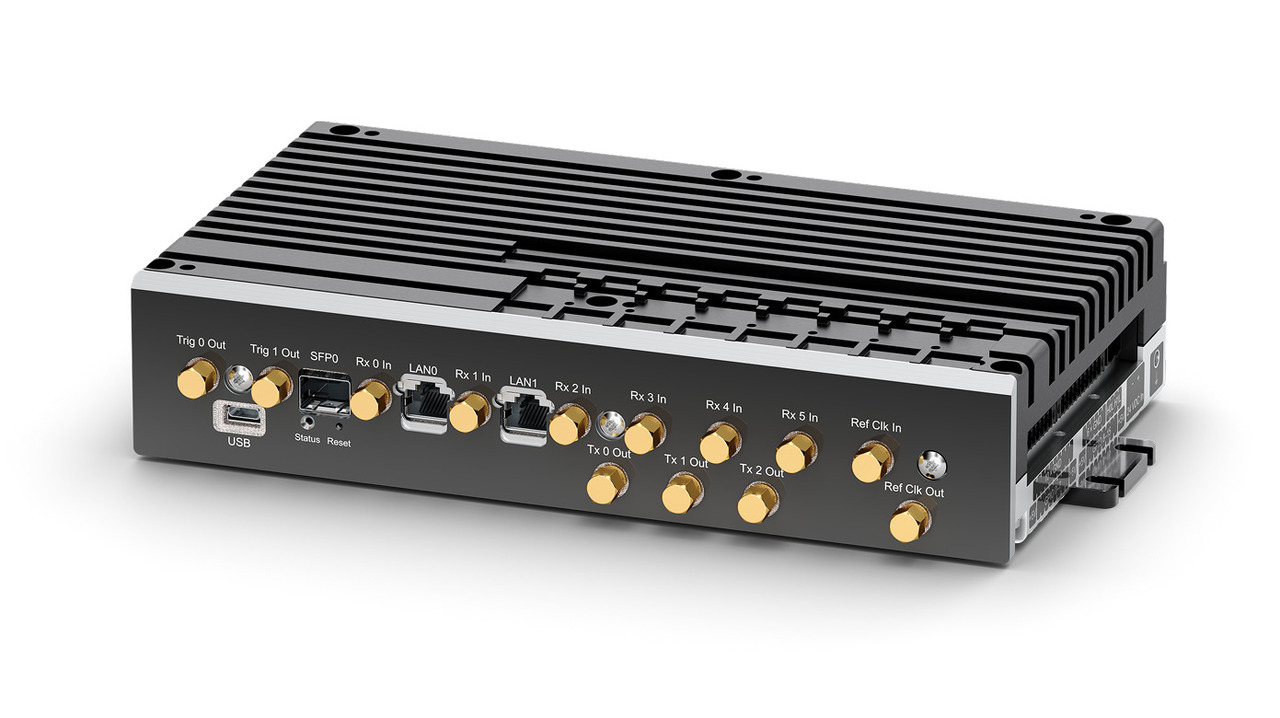
IFDR10 includes an external analog IF filter at each IF and burst sample input. The IF filters prevent aliasing of noise at undesired frequencies during the A/D conversion into the desired receive signal. Vaisala provides IFDR10 with IF filters with 14 MHz nominal pass band width at IF center frequencies 30, 57.5 and 60 MHz. For example, the 60 MHz filter pass band is 53 MHz … 67 MHz.
IFDR10 uses high-performance 16-bit A/D converters with a typical wide band SNR of 75.6 dB. The maximum power level at the input of the IFDR is +11.2 dBm.
The noise density at 1 MHz bandwidth using 210 MHz sampling rate can be calculated as follows:
RVP10 uses statistical linearization performed on signals that exceed the saturation level. RVP10 can recover the signal power accurately, even when the A/D converter is driven beyond saturation. The velocity data is also valid, but spectral width may be overestimated. This improves the dynamic range by 4 dB.
The weak coherent signal below noise floor at -4 dB SNR can easily be measured when 25 or more pulses are used. This improves the dynamic range by 4 dB compared to the signal level at SNR 0 dB.
As a summary, the total dynamic range of the IFDR10 is:
1 MHz bandwidth corresponds to approximately a 1-μsec transmit pulse. With a 2-μsec transmit pulse, the dynamic range is 3 dB higher. With a 0.5-μsec transmit pulse, the dynamic range is 3 dB lower.