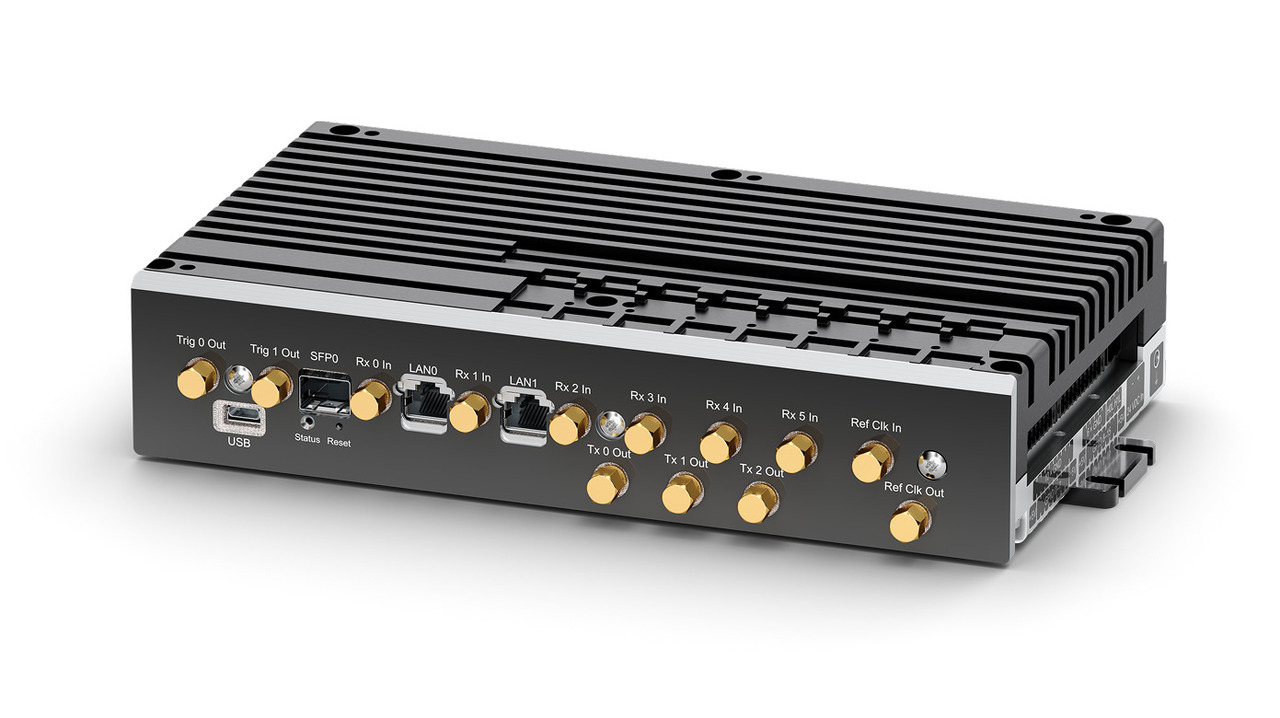
IFDR10 power, size, and mounting considerations
| Consideration | Description | ||
|---|---|---|---|
| Communication |
The IFDR communicates with a host computer through 10Gb Ethernet. The Auto-MDIX feature eliminates concerns about cross-over versus straight cables. The platform provides support for TCP and UDP packets. The default IP address, shipped with each system, is 10.0.3.254. The IFDR supports jumbo packets.
To comply with industry standards, use a shielded CAT5e cable (certified to 350 MHz), with shielded RJ45 plugs on each end. Ensure the Ethernet connectors on the host computer and IFDR make contact with the metal on the shielded cable, which provides DC return path. This design prevents ground loop currents from flowing between units, even when they are plugged into different AC/Mains. |
||
| Cooling |
The unit is cooled by direct conduction of heat through the metal chassis. One side of IFDR10 serves as a heat sink. The hotter chips mounted on the printed circuit board are bonded to the heat sink. Position IFDR10 so that air can freely convect around it. A minimum of 0.6 m3/min of air flow required. The ambient air temperature range is -40 ... +55 °C (-40 ... +131 °F). |
||
| Filters |
Reserve mounting space for the external, analog, anti-alias filters. The filters can be mounted nearby in the radar cabinet, or they can be attached directly to the IFDR, on the opposite side from the power module. |
||
| Mounting |
The unit is designed to be mounted on an edge. The IFDR is a compact sealed module with dimensions 246 mm × 136 mm × 51 mm (9.7 in × 5.4 in × 2.0 in). With the mounting bracket, the length of the module is 270 mm (10.6 in) and height 52.5 mm (2.1 in). |
||
| Power |
Nominal operating voltage is 24 VDC. Operating voltage range is 20 … 30 VDC. Typical power consumption is 36 W. |