
SURVEILLANCE
The SURVEILLANCE
task is optimized for long-distance detection of precipitation echo. It uses the longest
available pulse width of the weather radar system.
Dual-polarization systems use the enhanced
reflectivity Ze along with a large number of processed samples to
significantly improve the sensitivity when compared with single polarization systems. Samples
are collected from a large contributing area using a wider azimuthal spacing of the radar rays
(2°) and a range averaging over several consecutive range bins.
The default configuration has a maximum range of 450 km. Use it in warm climates. In cooler climates, lower the maximum range to, for example, 350 km in summer or 250 km in winter. Shorter ranges allow for higher pulse repetition frequencies (within the range) and more pulses can be configured within the constant run time.
The LOG threshold is optimized for tropical conditions with a clear margin of noise uncertainty, even in conditions of extreme rain. In cooler climates, with a calibrated radar, the LOG threshold can be as low as 1.2 dB.
The following figure shows the task configuration details for a dual polarization system. Blue circles indicate items with different values in single polarization systems.
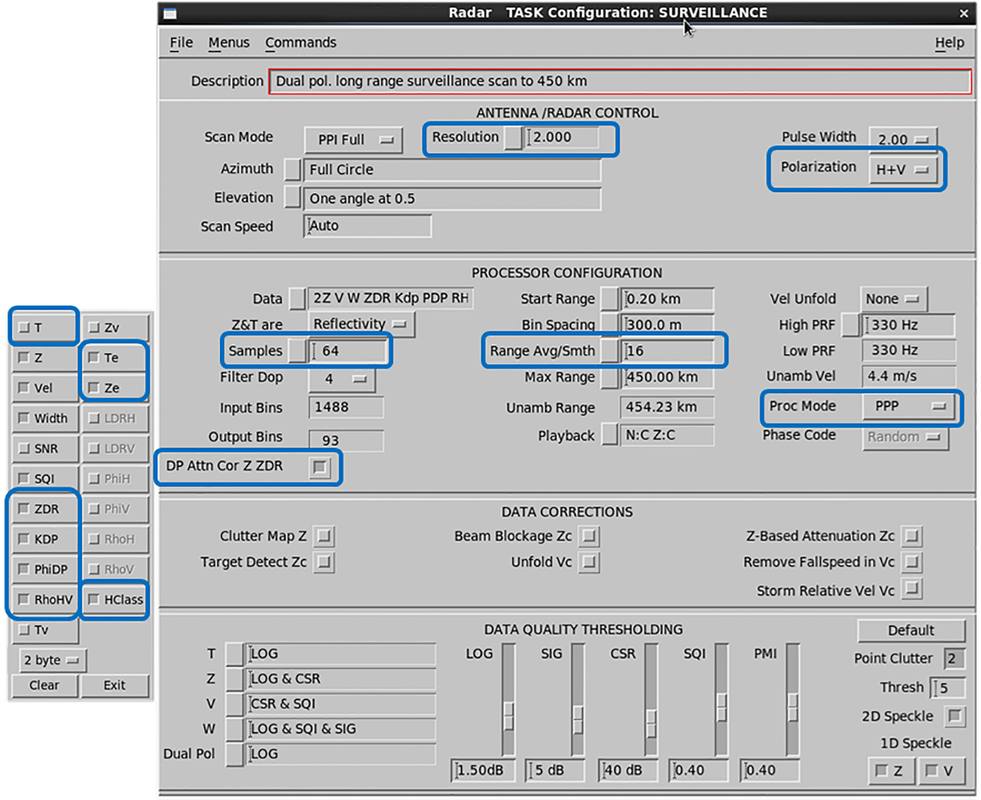
- Azimuth resolution
- 1.00°
- Polarization
- Horiz
- Samples
- 35
- DP Attn Cor Z ZDR
- disabled
- Range Avg/Smt
- 2
- Proc mode
- FFT
- Measured data moments
- T, Z, Vel, Width, SQI