

Product Generation
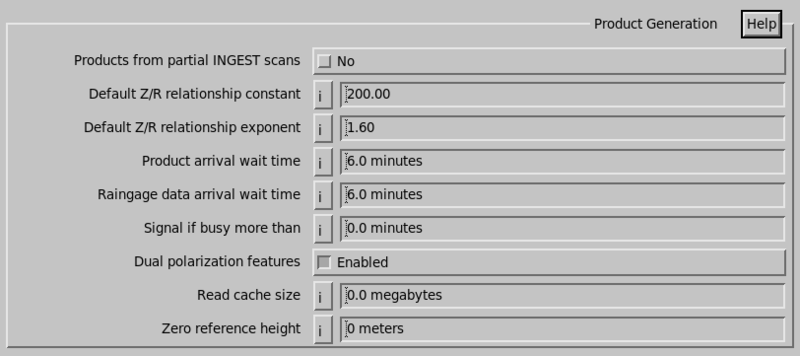
- Products from partial INGEST scans
- Select yes or no to indicate
whether products can be made from partial
INGESTvolume scans. - Default Z/R relationship constant/exponent
-
The system uses the following equation to express the relationship between reflectivity and rainfall rate:
- Z
- The linear reflectivity
- R
- The rainfall rate in mm/hr
- a
- Relationship constant, empirically determined for each site.
- b
- Relationship exponent, empirically determined for each site.
IRIS usually solves for R to convert the radar's reflectivity data to rainfall rate, as follows:
Typical values for rain are a = 200 and b = 1.6. Using these values, suppose reflectivity is measured at 20 dBZ. To solve for R, IRIS first converts dBZ to Z:
Then solve for R:
An increase in dBZ, from 20 to 50 for example, creates an increase in rainfall rate:
The values you enter for the constant and exponent depend on the climate at the radar site and experience gathered through use of the IRIS system.
- Product arrival wait time
-
Scheduling timeout for products that require several inputs, but which can run when some are missing.
Products which use this are:
COMP,NDOP(with 3 inputs), andRAIN1.For example, if a composite product requires 3 radar site inputs within 5 minutes. It gets 2 of those inputs, then the 5 minute interval expires. If the Product arrival wait time is set to 1 minute, then it waits for 1 more minute before running. This time is meant to cover possible time differences between the radars and differing network transfer speeds.
- Raingage data arrival wait time
- The time to wait for raingage data to arrive is set separately. This is used in the rainfall correction of the RAIN1 product.
- Alternating polarization features
- This question enables the listing of the data types ZDR and KDP, and also the listing of the K/R relationship in many of the menus. It also enables the following questions on the K/R relationship below.
- Default K/R relationship
- These number allow control over the default KDP-R relationship, similar to the Z-R relationship above.
- Read Cache size
-
The IRIS memory mapped I/O library routines support caching file read. It only operates for reading files. Making this size nonzero disables memory mapping and uses the specified cache size in the product generator.
If your system supports memory mapped I/O, then you may want to keep the caching size at 0. If you do not have memory mapped I/O, then benefits can result by setting the cache size to the approximate size of the INGEST volume scans that are being processed. However, if there is not enough main memory to hold these cached data, then the product generator is swapped to disk and no performance benefit are achieved.
- Zero Reference Height
- Enter the height in meters above MSL used for 0 in the product generator. Generally this should be 0 for mean sea level, but for radars far inland, you might want a different reference. All radars to be composited together should have an agreed upon reference. All heights displayed with the user cursor are relative to this reference.