
Variable Width Clutter Filter
This is similar to the fixed width filter, except that the algorithm attempts to extend the boundary of the clutter by determining which is the first component outside the clutter region to increase in power.
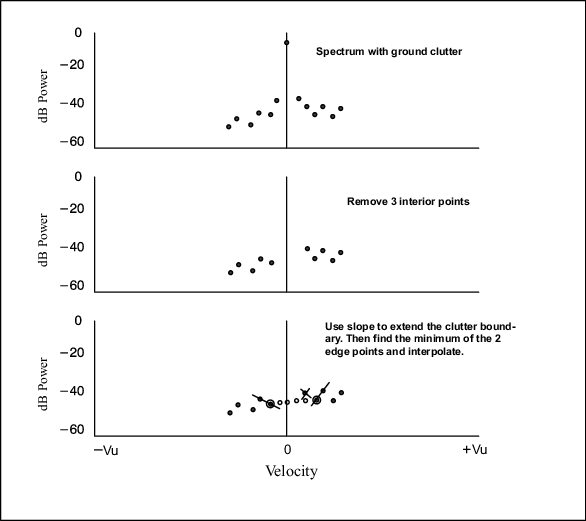
In the figure, the minimum number of points to reject is set to 3. The filter starts at zero velocity and checks the slope to determine the point at which the power starts to increase. In the example, this results in the filter being extended by one point on the right. Note that there is a selectable maximum number of points that the filter "hunts". The use of the edge points for interpolation is identical to the fixed width case.
This filter allows users to specify a narrower nominal filter than the fixed width case and then when the clutter is strong, this width is extended by the algorithm (the "hunt"). The interpolation attempts to preserve any overlapped clutter and weather.