
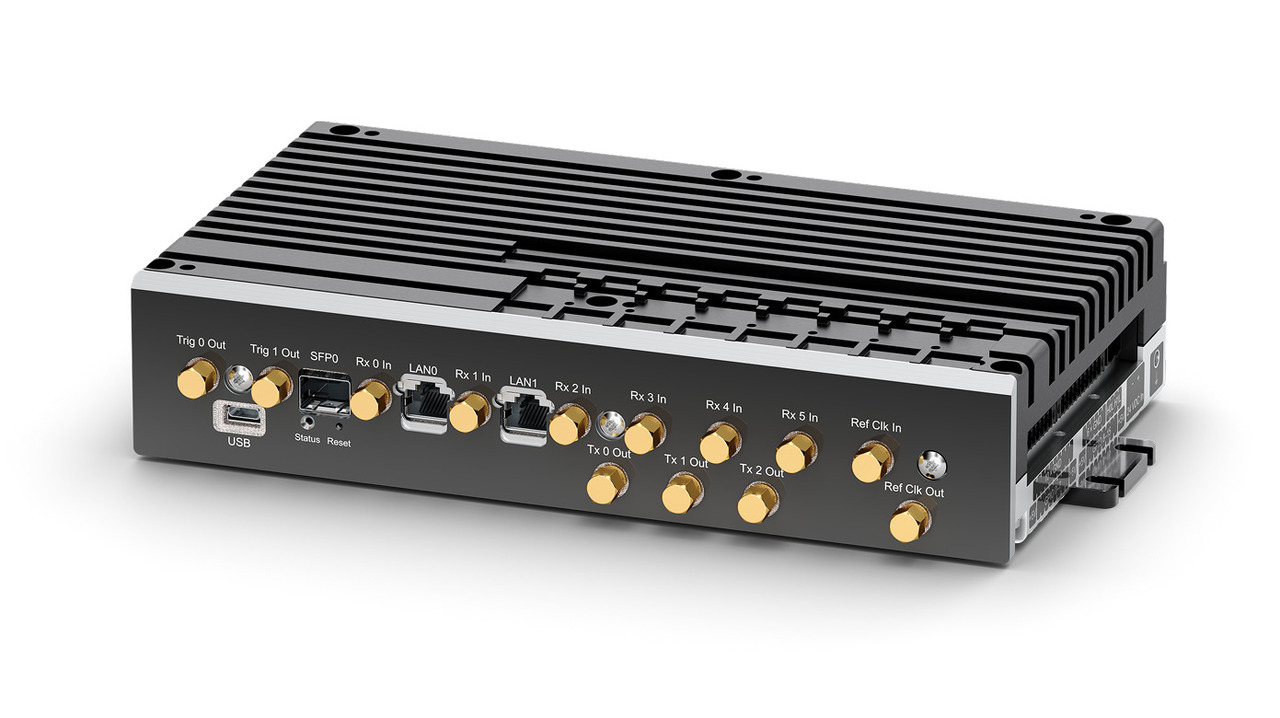
TS record and playback software architecture
The TS record and playback features on a local RVP10 and a remote archive host share a common software architecture. The following figure shows the most general case.
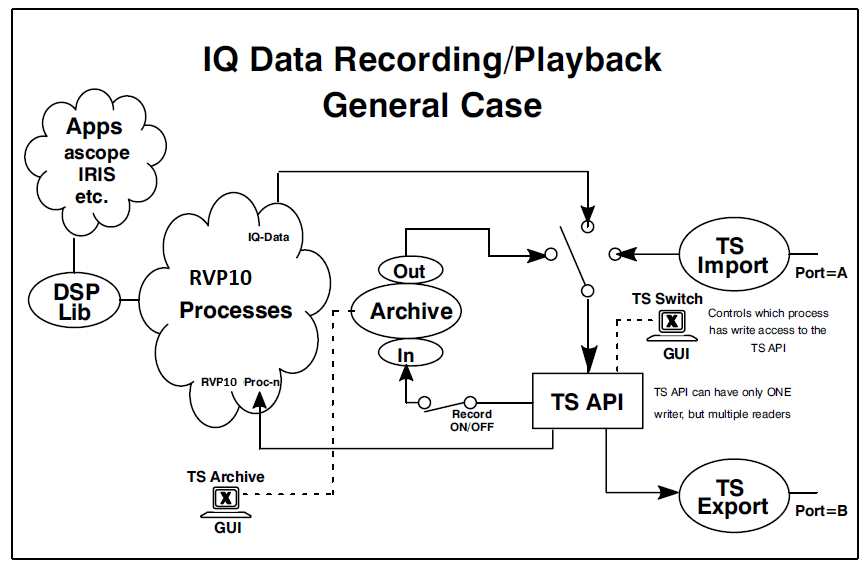
The structure shown runs on a single machine. Replicas of this structure, with pieces included or excluded, can be run simultaneously on several machines to handle different scenarios, such as a separate archive host. This modular design does not make a strong distinction between RVP10 and a separate archive host operating in record or playback mode.
| Process | Description |
|---|---|
TS API |
Where the time series data reside in memory. The time series can be written to the TS API from one of the following sources:
|
tsswitch |
GUI that allows the user to select the sole TS writer from among these three possible sources. See TS Switch Utility. |
tsarchive |
Handles both the recording and playback of data. It has its own GUI to select record/playback mode and which directory contains the local disk archive.
See TS Archive Utility. |
|
|
Provide the ability to receive/send time series over a network. Either a 1000 BaseT (gigabit) or 100 BaseT Ethernet can be used depending on the typical mode of operation and the competing network traffic. For example: In the example, The output is through UDP broadcast.
This is a very efficient way to transfer data since there is virtually no overhead
as compared to standard TCPIP. The socket ports are configured so that the
tsexport on one system connects to the |
| RVP10 Processes |
Collection of processes that are only present on an RVP10 machine. The important functions are:
To view these processes, use the v command in dspx. A remote archive host is most likely not from RVP10. In this case, these processes do not exist. |