TDWR/LLWAS Integrator and Runways Utility
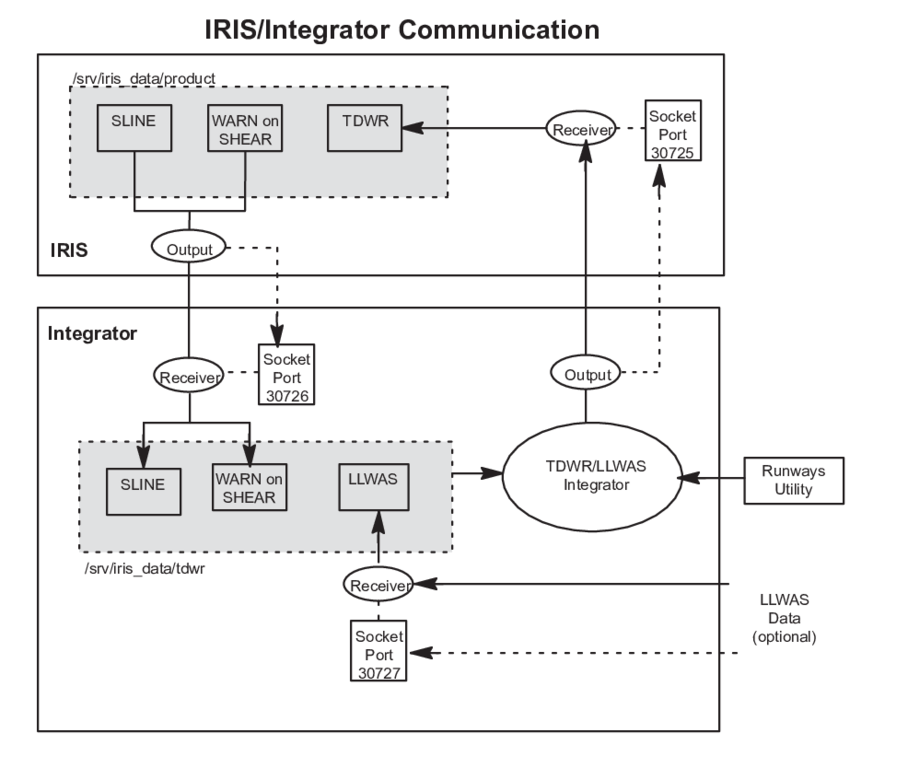
The TDWR/LLWAS Integrator is a separate software process (that is not part of the main IRIS software) which combines wind shear alerts from IRIS and an optional LLWAS system to generate TDWR products. The Integrator functions as a filter on the alerts, that is, the integrator:
- Only passes alerts for runways that are active as specified by the runways utility.
- If an arena has 2 or more alerts, then the more important alert is passed, for example, a microburst alert is more important than a wind shear alert.
- Only passes the alert for the arena of
first encounter in a corridor. For example, if
33L_3MFand33L_2MFboth have microbursts alerts, then the33L_3MFis alerted on the ribbon display since an aircraft would encounter this first. - In the event of failure of a system, the failed system uses the alerts from the other system, for example, if TDWR fails, then only LLWAS data is used.
- For each arena, the alerts from TDWR and LLWAS are combined as follows: a strong alert (MBA) from either system is passed through, while a weak alert (WSA) requires confirmation from the other system. The thresholds for what is considered strong and weak are tuned for each site.
The TDWR products from the Integrator are sent back to IRIS for distribution to SD's to drive the ribbon displays. See Data Flow for Ribbon Display Generation.
The Integrator takes as input the following data:
- SLINE products from IRIS (gust front warning)
- WARN (on radial shear) products from IRIS (microburst warning)
- LLWAS input data (if available, for LLWAS warnings).
- Active runway configuration from the runways utility.
A new TDWR product is made and output to IRIS when:
- New input data are received.
- The active runway configuration is changed.
- A maximum time-out has expired (specified time of order 60 seconds).
- The product sitename is the same as the radar sitename.
All of the inputs are used when a TDWR product is made, unless an input is "stale", that is, it is older than a specified time (of order 120 seconds). For example, if LLWAS fails, the Integrator continues to use the old LLWAS data until the time limit for "stale" data is reached. If all of the data are "stale", no TDWR product is made at all. In this case, there is no output to IRIS and the ribbon displays eventually show NO DATA AVAILABLE.