

NDOP : Multiple Doppler
NDOP provides a mechanism for including velocity (Doppler) data from another radar site now enabling the measurement of horizontal wind in addition to vertical wind.
A single Doppler radar measures one component of a 3D wind vector, that is, the component of wind towards or away from the radar: the radial wind. We can think of the 3D wind vector as being made up of the 2D horizontal wind and the vertical wind. Typically the horizontal wind is much stronger than the vertical wind, except in local areas of strong convection.
With a second Doppler radar, we can measure 2 components of the wind, provided that the radar beams are crossing at some angle (not parallel). If the vertical component of the wind is assumed to be small, then with 2 radars we can measure the horizontal wind.
The following figure shows a plan view
(looking down) of the dual Doppler geometry. The horizontal wind is sampled by each radar
which measures the radial component of the wind, Vr1 and
Vr2. These two radial velocity measurements at the same point, along with
some simple trigonometry, can be used to estimate the horizontal wind at the point, provided
that the crossing angle is not 0° or 180° (parallel beams).
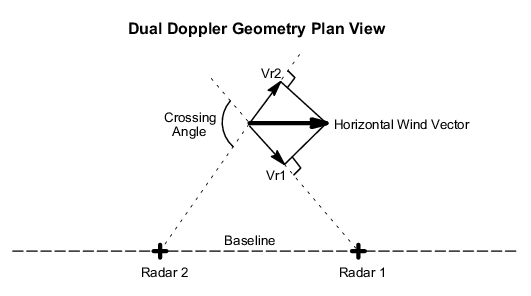
This means that along the baseline (crossing angle 0°) or at far ranges (crossing angle 180°) we cannot use the algorithm, since the two radars essentially measure the same radial wind.
While in theory the crossing angle could be anywhere between 0° and 180°, our radial velocity measurements are not perfect so that in practice, a crossing angle of <20° leads to unreliable wind estimates.
The NDOP product performs the dual Doppler algorithm to obtain estimates of the horizontal wind field. NDOP makes the following assumptions:
- The vertical wind is assumed to be weak as compared to the horizontal wind.
- The input radial velocity measurements represent the radial velocity of the air, that is, the velocity is unfolded and corrected for particle fallspeed.
The output of the NDOP product is a multi-level grid of horizontal wind vectors. These can be displayed by themselves, or overlaid on other echoes.