

SHEAR: Wind Shear
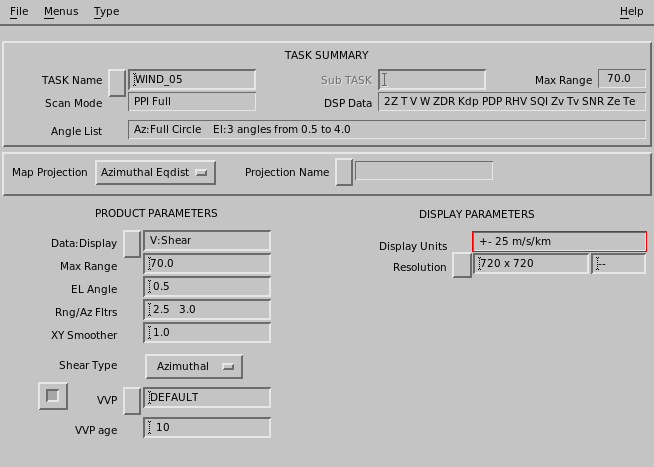
SHEAR detects wind shear in the atmosphere, allowing the detection of microbursts, gust fronts, mesocyclones, cold fronts, and atmospheric waves.
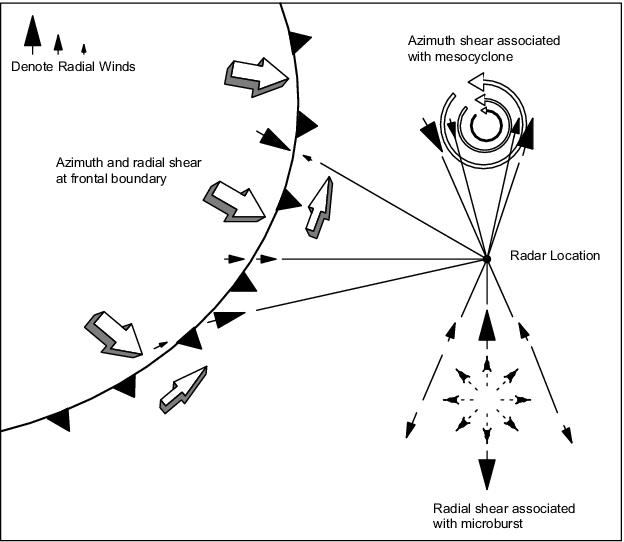
Wind shear is associated with many phenomena:
- Microbursts
- Associated with convective storms. Extremely hazardous to aircraft during landing or takeoff. Microbursts are characterized by positive values of the radial shear (strongly divergent outflow) in a roughly circular region, typically less than 3 km (1.9 mi) in size.
- Gust Fronts
- Caused by cold outflow from a convective storm (perhaps a microburst) colliding with the surrounding air. They are characterized primarily by negative values of the radial shear (convergence). However, depending on the geometry, they can also create positive values of the radial shear and azimuthal shear of either sign.
- Mesocyclones
- Characterized by rotation. Mesocyclones are associated with tornadoes. The azimuth shear is used to detect mesocyclones.
- Cold Fronts
- Similar to gust fronts, but much larger in extent.
- Atmospheric Waves
- Produced at a variety of wavelengths and intensities. The shear values can be positive or negative, depending on the nature of the wave and the "phase" being observed.
IRIS can compute the following types of basic shear values for the radial component of the wind:
-
Radial shear
Computed by differencing the radial velocity in range. Positive values are for radial velocity increasing (more away) with range. Divergence of the radial wind is positive.
-
Azimuthal shear
Computed by differencing the radial velocity in azimuth. Positive values are for radial velocity increasing (more away) in the clockwise direction. This corresponds to positive vorticity.
-
Elevation shear
Computed by differencing the radial velocity in elevation. Positive values are for radial wind increasing (more away) with height.
In addition to the basic shears, combinations are computed using RMS values. For example, the total combined shear magnitude is:
Where RAD,
AZ, and EL denote the basic shear values. Combined
shears are positive.
 |
Vaisala does not warrant that the SHEAR product will detect all hazardous shear conditions. When convective storms are in an air terminal area, there is danger of microburst. The SHEAR product is only one of many indicators that such a hazardous condition may exist. Normal precautions to avoid suspected wind shear should be used, even if the SHEAR algorithm does not detect shear. Vaisala shall not be liable for damages of any kind for failure of the SHEAR algorithm to detect hazardous wind shear or for false alarms that may occur from use of the SHEAR algorithm. |
- To create a new SHEAR product, select .
- To load an existing product, select
-
In Data:Display, select
V Shear. -
In EL Angle, define the elevation angle of
data you want to display.
Wind shears associated with gust fronts and microbursts are usually low-level phenomena, so angles of 1° or less are typically used to detect these.
-
Define Rng / Az Filter.
The first number defines the range length scale for the SHEAR product, in km. This distance determines the size of the skip that the SHEAR product can tolerate when differencing over missing data. It also specifies the length of the radial smoother, which is applied before the XY smoother.
The second number is the azimuth length scale in degrees.
The skipping and azimuth range length are analogous to the range filter.
-
In Shear Type, select which type of shear you want to
compute:
-
Radial Shear
The bin-to-bin difference in the radial velocity.
-
Azimuthal Shear
The azimuth-to-azimuth difference in the radial velocity.
-
Elevation Shear
The difference between the radial velocity at the selected and next higher elevation angle. Requires a volume scan.
-
Combined Shears
The RMS value of the radial, azimuth, and/or elevation shear. This is sometimes referred to as the total shear.
-
-
In VVP, select the name of a VVP product.
The wind speed and direction from the nearest VVP wind product of this name is used to remove the effects of the mean wind on the azimuth shear calculation.
This VVP product must be scheduled to run. Use of the azimuth or combined shear is not recommended without this correction.
-
In VVP Age, specify the maximum number of minutes between the
data for the VVP product and the data for this product.
This prevents old VVP winds from being misapplied. If a VVP product is not found in this time window, the mean wind correction is not applied when computing the azimuth shear.