
Optional Data Parameters
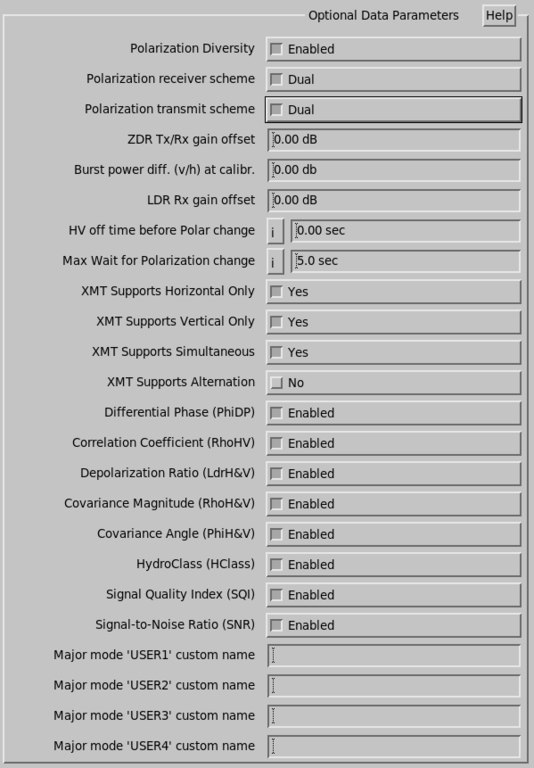
- Polarization Diversity
-
Select whether your radar supports multiple polarizations.
The figure shows an example with polarization diversity turned on.
- Polarization receiver scheme
-
Select the type of polarization receiver system you have. Choices are Single and Dual.
Select Dual for receivers on both the co- and cross-polarized channels. This allows measurement of depolarized power, for example. For more information, see dual-polarization processing algorithms in RVP10 User Guide (M212604EN).
- Polarization transmit scheme
-
Select whether the radar has a single tranmitter or two transmitters.
”Polarization transmitter scheme” field active only when ”Polarization Diversity” enabled.
If Polarization transmit scheme: single:- In Calibration:
- Test signal gen. control in use
- Test signal level
- In Pulse Width #x:
- Burst power at calibration
- Digital filter loss at calibration
If Polarization transmit scheme: dual:- In Optional Data Parameters: Burst power diff. (v/h) at calibr.
- In Calibration:
- Test signal gen. control in use
- Horiz test signal level
- Vert test signal level
- In Pulse Width #x:
- Transmit power at calibration (V)
- Burst power at calibration (H)
- Burst power at calibration (V)
- Digital filter loss at calibration
- In Calibration:
- Burst power diff. (V/H) at calibr.
-
This field is active when Polarization Diversity is enabled and Polarization transmitter scheme is set to Dual.
- Signal Quality Index
-
Select if you wish to allow the recording and display of SQI.
This enables SQI options in the task configuration menu and in Ascope.
- Signal-to-Noise Ratio (SNR)
-
Select if you wish to allow the recording and display of SNR.
This enables SNR options in the task configuration menu and in Ascope.
- Major mode 'User 1' custom name
-
Use these optional fields to take advantage of the extensibility of the RVP API and specify customized Major modes.
See RVP10 User Guide (M212604EN).
Single Polarization Radar
- Polarization
- For fixed polarization radars, enter the type of polarization here. Options are Horizontal and Vertical.
Dual Polarization Radar
 | RVP requires a license to produce dual-pol data. |
For radars with polarization diversity, the following configuration options are available:
- ZDR Tx/Rx gain offset
-
This is an offset used on systems able to calculate ZDR if there is a difference between the gain at the 2 different polarizations which results in a bias.
This number is added to the ZDRs otherwise computed. It is stored to the nearest 1/16 of a dB.
- LDR Rx gain offset
-
This is an offset used systems able to calculate LDR if there is a difference between the gain at the 2 different polarization receivers which results in a bias.
This number is added to the LDRs otherwise computed. It is stored to the nearest 1/100 of a dB.
Polarization Handling
The following parameters manage polarization handling:
- HV off time before Polar change
-
When the transmit polarization is changed, the
dsplibrary turns off the high voltage this much in advance of the switch.This is needed on some systems to prevent arcing while switching.
For Vaisala systems, the default value is 1.0 seconds.
To disable the feature, enter a value of 0.
- Max Wait for Polarization change
-
Enter the worst case time it could take to switch polarization.
The
dsplibrary waits for confirmation of the new polarization, up until this time is exceeded.If there is no confirmation, then this time is always waited. If the high voltage was turned off before the switch, it is turned back on after the wait.
For Vaisala systems, the default value is 3.0 seconds.
- XMT Supports...
-
Defines which transmit modes the transmitter supports (H only, V only, simultaneous H+V, alternating H+V).
Vaisala radars support H only and simultaneous H+V.
Available Polarization Moments
Use the following parameters to select which types of polarization transmission are available on your radar:
- Differential Phase (PhiDP)
- Correlation Coefficient (RhoHV)
- Depolarization Ratio (LdrH&V)
- Covariance Magnitude (RhoH&V)
- Covariance Angel (PhiH&V)
- HydroClass (HClass)
- Signal Quality Index (SQI)
Enable all polarization parameters that can be measured by your radar system. There is no question for ZDR, because that is available on most dual-pol radars.
| HydroClass requires a license in RVP. |