
Signal processing options
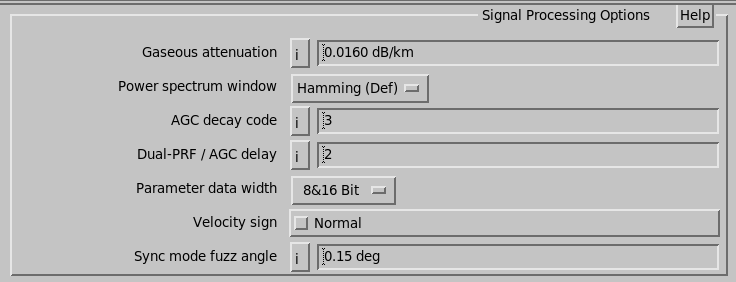
- Gaseous attenuation
- The gaseous attenuation constant determines the atmospheric attenuation in dB/km used by RVP when acquiring radar data. For a 5-cm radar, a reasonable default value is 0.016 dB/km.
- Power spectrum window
-
Select the type of window that the signal processor should use when power spectra are computed. Choices are:
- Rectangular
- Hamming (Def)
- Blackman
- AGC decay code
- Enter the time constant of the exponential average applied to the log receiver to produce the AGC signal. ONLY used on the RVP6 processor only, and it is typically set to 3.
- Dual-PRF / AGC delay
- Enter the number of pulses to send through the clutter filters prior to the start of each ray. These pulses stabilize the filters. Typically set to 2.
- Parameter data width
-
- 8-bit
- 8&16-bit. In this mode, you can select the data width in the task configuration menu.
- Velocity sign
-
-
Normal.
Vaisala recommends that you set this parameter to Normal unless you have another computer wired up to the signal processor which displays velocities reversed and cannot be changed.
-
Inverted.
IRIS inverts the velocities as they are read from the signal processor, and the Ascope utility reverses the T and A signs on its display.
-
- Sync mode fuzz angle
-
The suggested value for this is 0.15°. If IRIS uses angle sync mode, this controls the tolerance.
For more information, see RVP10 User Guide (M212604EN).