
Signal Processing and Data Storage
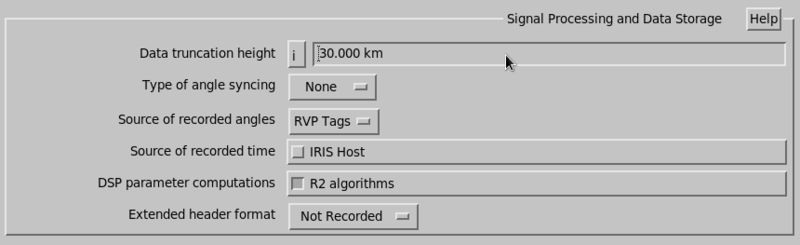
- Data truncation height
- Any data calculated to be above this height are removed to save disk space. This is typically set to 20 km (12.4 mi). This is height above the radar dish. This truncation is not applied to manual scans.
- Type of angle syncing
-
Select the method of angle syncing as Static, None, or Dynamic.
- Source of recorded angles
-
Enter one of the following values:
-
RVP Tags
Angle information supplied by the RVP.
-
IRIS Host
Angles are taken directly from the antenna interface software. This choice is used for simulations where the signal processor does not have angle information. It is not recommended for operational systems.
-
- Source of recorded time
-
Enter one of the following values:
-
RVP Tags
Time for each CPI is logged on RVP8. This feature is only available on RVP8 systems. Active Ingest task scheduling is still based on the IRIS host computer, so such systems should be time synched.
-
IRIS Host
Time for each CPI is taken directly from the IRIS host computer. Because of buffering, data arrives and is time tagged in groups of 2 or 3 CPIs.
-
- DSP parameter computations
-
Choose either R2 algorithms or R1 algorithms.
Use the R2 processing algorithms to estimate SNR and spectral width.
You must set the RVP TTY Setup R2 processing question to user for this selection to take effect.
- Extended header format
-
Enter one of the following values:
-
Not recorded
Doesn't record extended ray headers.
-
V0
Records time and calculations
-
V1
Records time and navigation.
Vaisala recommends not recording extended ray headers if they are not required.
-