

LAYER: Layer Average
LAYER can compute layer averages of any polar data types in the ingest files.
LAYER can also convert to liquid first and compute VIL Density. When computing VIL Density, the output is in g/m**3.
The LAYER algorithm is similar to VIL, except that it divides by the layer thickness. The algorithm process is:
- Searches out all points in the layer (accounting for earth curvature) over a given range and at a given azimuth that intercept the PPI scans of the volume scan, including one point above and below.
-
If the data is
Z, it linearizes it.If the output is VIL density it converts the
Zvalues toWvalues (Wrefers to water content), and averages the values in the layer.Each data point is assigned a weighting corresponding to the height interval that it represents in the layer.
- The result is an intermediate PPI product that is transformed to a Cartesian product and stored.
- If
Zis selected as the product data parameter, but at run time onlyTis available (or vice versa), the product runs with the available data parameter.
LAYER can function when only one angle is in the task, but for best results, this is not recommended . If no angle in the associated task passes through the layer, no result can be calculated.
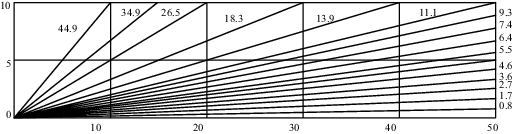
For a layer of 5 ... 10 km (3.1 ... 6.2 mi), in the volume scan example in the following figure, layer averages cannot be calculated for ranges less than 5 km (3.1 mi). In the resulting product display, there would be an inner circle of an unscanned area.
- Select .
-
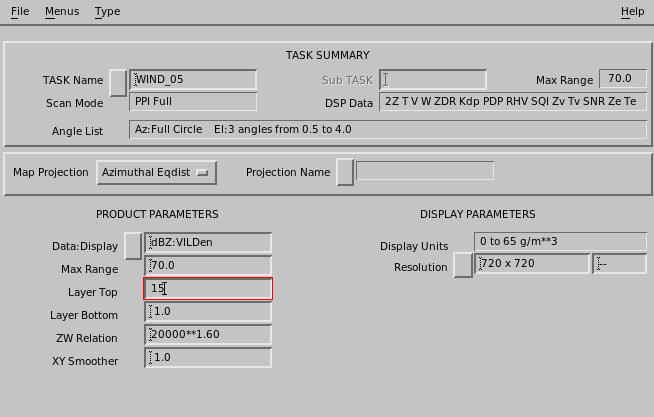
In Data:Display, select the type of data that is computed.
-
To compute VIL Density data, select one of the following:
- dBT:VILDen
- dBZ:VILDen
- dBZc:VILDen
-
To compute a layer average, select any other data type.
-
- In Layer Top and Layer Bottom, select the top and bottom heights of the layer in kilometers and tenths of kilometers.
-
If you are computing VIL Density, in ZW
Relation, select the reflectivity-water content (Z-W) relationship.
The default value is for rain. For snow, reduce the coefficient to a smaller value, such as 2000, to account for the lower reflectivity of ice.