

RAIN1: Hourly Rain Accumulation
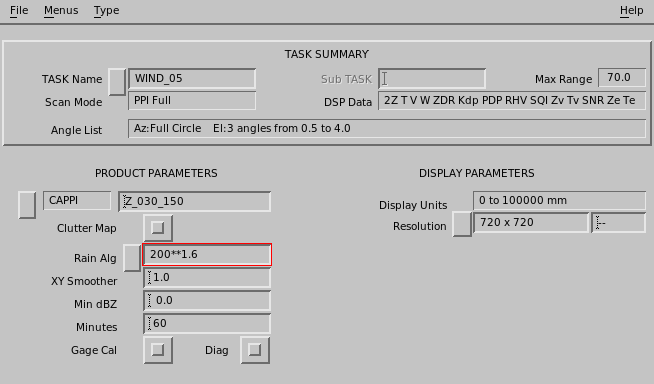
RAIN1 is hourly rainfall accumulation.
The RAIN1 product uses CAPPI or SRI data over a defined time interval, generally 60 minutes, to obtain an estimate of the rainfall that fell in that hour. The results can be displayed or used to derive the RAINN or CATCH product.
A general-purpose volume scan task usually serves for the rainfall product. Note that the accuracy of the rainfall product degrades with range because the beam is larger at greater ranges. For example, the beam for a 1° beam width is 3 km across at 180 km range.
 | If you have a Doppler radar, select Z as one of the task data outputs. This is corrected for ground clutter effects. |
- Select .
-
Select the product type (either CAPPI, or
SRI) and the name of an input product.
When using CAPPI as input product, make sure the number of layers field (next to the Resolution field) is 1.
The input data type can be corrected
dBZ, uncorrecteddBZ, or rainfall rate.If you are integrating rainfall rate inputs, the Minimum dBZ field is not applicable.
The priority of the RAIN1 product must be lower than that of the CAPPI and SRI products to ensure that all of the inputs are ready before the RAIN1 product is made. Use the setup utility's product command to set the relative priorities of products.
-
To enable clutter maps, select Clutter Map.
To use this, you must make a RAIN1 product with a matching name and resolution in clear weather.
This file is then subtracted from each hourly accumulation. The clutter map file is marked in the Product Output Menu.
-
In Minimum dBZ, set the minimum value of
dBZused to compute rainfall amounts.dBZvalues that are less than this are treated as 0 rainfall.This prevents very weak echoes from being counted as rainfall.
In most cases, set this to -10 dBZ, although you should choose a value appropriate to your site.
Set the value to -33 to disable Minimum dBZ.
-
In Minutes, set the desired time period for rainfall
accumulation.
Generally 60 minutes is used to produce a one hour rainfall product, but you can use shorter intervals. The minimum accumulation time is 15 minutes.
- If you have purchased the IRIS/Hydromet software license, select Gage Cal to have the product use the raingage correction algorithm.