

VVP: Velocity Volume Processing
VVP provides line graphs or time against height cross-sections of wind speed, wind direction and divergence against height.
VVP obtains the following parameters averaged over a volume centered about the radar:
- Horizontal wind speed and direction
- Particle vertical velocity (airspeed and particle fallspeed combined)
- Horizontal divergence (related to vertical air motions)
- Horizontal deformation and axis of dilatation (related to frontal forcing)
- Average reflectivity
- Average
RhoHV
You can select which data is calculated and store the resulting product. You can also turn data and be on or off. Note that for the top 4 velocity-related buttons, any button turned on implies those above are also turned on. You must also turn on at least one data type.
This algorithm is similar to the VAD technique, with an improved analytical approach. 1
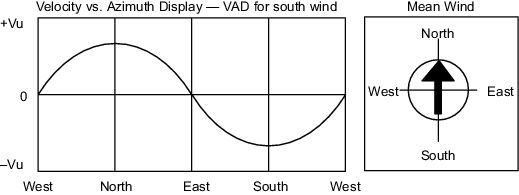
A Doppler radar can only measure the component of wind either towards or away from the radar. This is called the "radial wind." However, by looking at the wind over all azimuths around a full circle, the average wind speed and direction can be determined. This is shown schematically in the following figure for the case of a South wind. The figure shows the radial velocity at a range bin as a function of azimuth. When the radar points directly south, the radial velocity measures the full speed of the wind (toward the radar). The IRIS convention is that positive radial velocities are away from the radar. When the beam points East or West, there is no component of the wind toward the radar, so the radial velocity is 0. The divergence over the radar is estimated by taking the average of the radial velocity. Other kinematic parameters can be estimated, such as the deformation and the axis of dilatation of the wind.
The VVP algorithm assumes that the wind field varies linearly and computes the mean wind speed and direction and divergence as a function of height. For each height interval, the VVP algorithm performs a least squares fit of the observed radial velocity to linear windfield model. Many thousands of points are used. The output is a line graph display of each of the 3 parameters against height with error bars to indicate the uncertainty in the least squares fit.
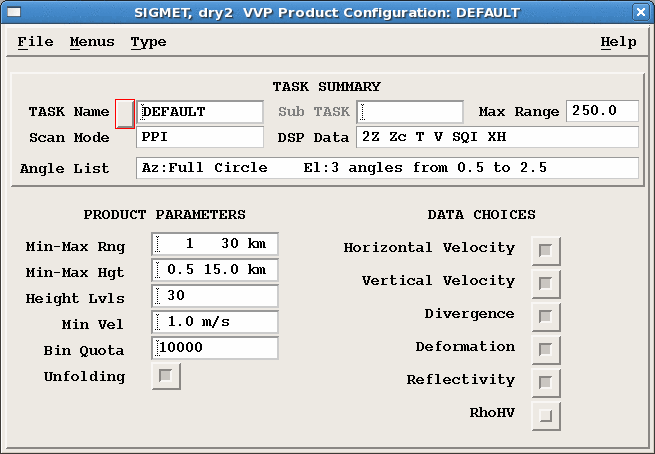
The VVP Product Configuration menu requires no display configuration for the line graphs.
- Select .
-
Configure the VVP product:
- Min/Max Range
-
Select the minimum range to avoid strong ground clutter near the radar, for example, 2 ... 5 km (1.2 ... 3.1 mi).
Select the maximum range so that the highest elevation angle extends past the maximum height that you select.
No comma is required to separate the numbers.
- Min/Max Height
- Configure the minimum and maximum height to cover the span of altitude where you want wind information.
- Height Levels
- Specify the number of height intervals. The example in the figure covers the height span from 0.5 ... 15.0 km (0.3 ... 9.3 mi) in 20 intervals, so one value for each 500 meters (0.3 mi).
- Min Velocity
-
Specify the minimum velocity to be included in the wind volume fit.
The recommended value is 0.5 m/s (1 ft 8 in / s).
This is a simple way to remove bias toward 0 at low heights due to clutter which passes the clutter filter.
A value of 0 disables Min Velocity.
- Bin Quota
-
The maximum number of bins that is included in the least squares fit for each height interval. The maximum allowed is 10,000 bins. Vaisala recommends using the maximum of 10,000.
If you only select the mean velocity (that is, vertical velocity, divergence and deformation are not selected), you can reduce the bin quota for faster product generation.
- Unfolding
- Unfolding can be turned on or off.
- Reflectivity, Vertical Wind, Divergence, Deformation
- VVP can optionally compute the vertical velocity, deformation, and axis of dilatation of the wind field and the mean reflectivity profile above the radar.
-
Configure the associated VVP task.
The VVP algorithm performs unfolding of the data. For best results, configure a task with a large unambiguous velocity range.
That is, use a high PRF (such as 1200 Hz) and dual-PRF velocity unfolding (either 4:3 or 3:2) so that velocity folding does not occur.
If your standard volume scan does not use dual PRF unfolding, you might want to set up a separate task for the VVP.
Four elevation angles, such as 30, 20, 10, and 5°, are usually adequate because each angles contribute to many heights.